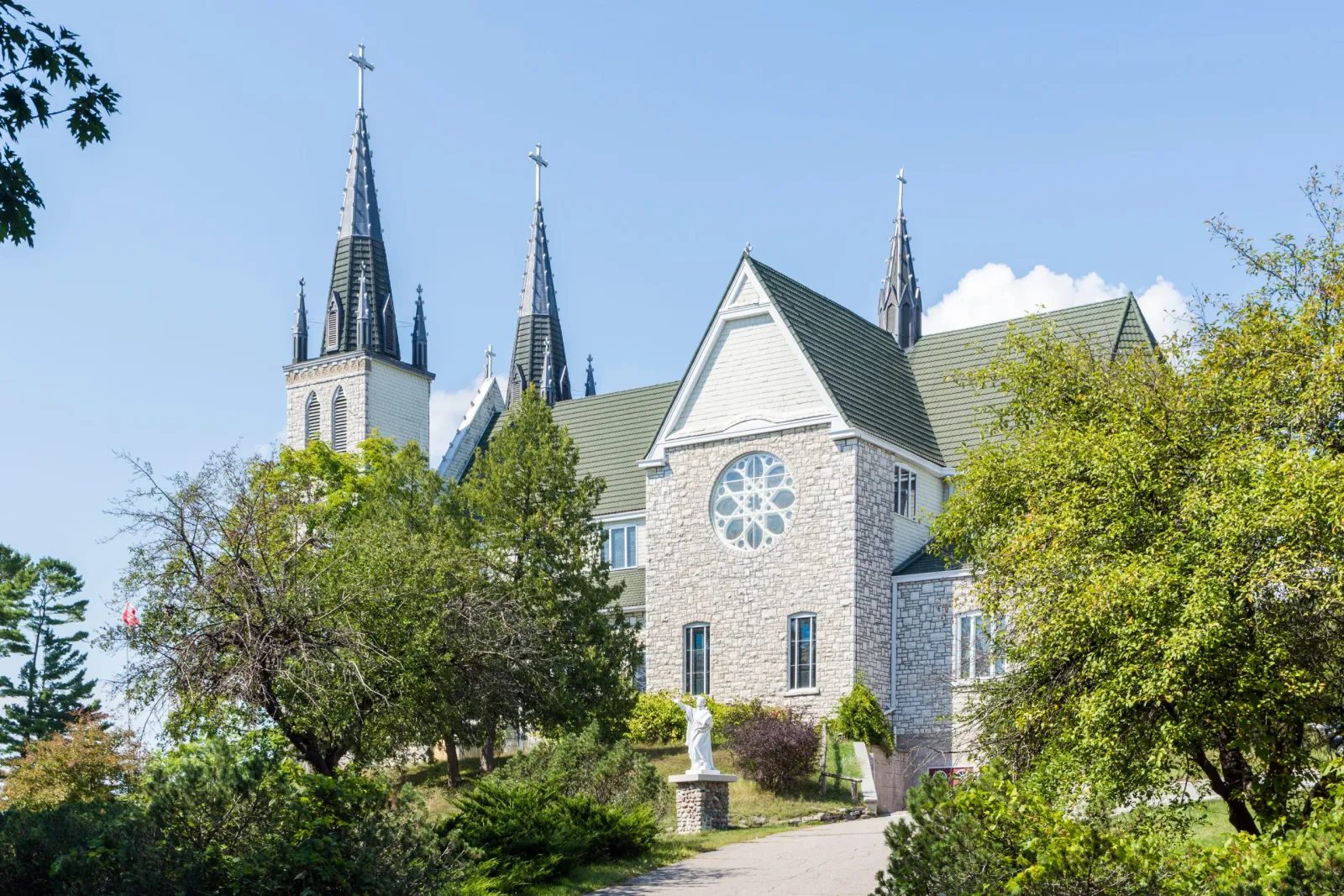
On September 26, the Church remembers eight men whose blood consecrated the soil of what is now Ontario and upstate New York: Saints Jean de Brébeuf, Isaac Jogues, Gabriel Lalemant, Antoine Daniel, Charles Garnier, Noël Chabanel, René Goupil, and Jean de Lalande — the Canadian Martyrs, as they are known here, or the North American Martyrs more broadly. Six were priests of the Society of Jesus; two, Goupil and Lalande, were laymen serving as donnés, giving their labour to the mission without vows.
The Mission
These men arrived in New France between 1625 and 1649, sent to evangelize the Huron-Wendat and other Indigenous nations of the Great Lakes region. It was gruelling, patient work — learning Wendat and Iroquoian languages, living among communities whose worldview and customs were entirely foreign to them, enduring the brutal winters of a land with no roads, no shelter but bark longhouses, and no guarantee of welcome. Brébeuf, the towering figure among them, spent nearly two decades in the mission field and became so fluent in Huron life that he composed what may be the first Canadian Christmas carol, the “Huron Carol,” in the Wendat language.
Their evangelization coincided with catastrophe. European contact brought smallpox and other epidemics that devastated Huron communities, and some blamed the Black Robes for the plague — a suspicion that hardened as the Iroquois Confederacy, armed by Dutch traders and locked in a struggle for the fur trade, began systematically destroying Huron villages in the late 1640s.
Their Deaths
Between 1642 and 1649, the eight died at Iroquois hands under a range of brutal circumstances tied to this wider war. René Goupil, a former surgeon, was tomahawked in 1642 for making the Sign of the Cross over a child — the first of the group to die, and arguably the first martyr of Canada. Isaac Jogues survived capture and mutilation, was ransomed by the Dutch, returned to France, and then — astonishingly — asked to go back to the missions. He was killed in 1646 at Ossernenon, in present-day New York, along with Jean de Lalande.
The most harrowing deaths came in 1649, when Iroquois forces overran the Huron mission village of Saint-Ignace. Brébeuf and his young companion Gabriel Lalemant were captured and subjected to prolonged torture — ritual mockery of baptism, mock-baptism with boiling water, mutilation — that both men endured, by every account, with extraordinary composure. Brébeuf reportedly encouraged the other captives even as he suffered. Antoine Daniel died that same year defending his mission church at Saint-Joseph, shot while giving his people time to flee. Charles Garnier and Noël Chabanel died in the same wave of destruction that scattered the Huron nation and effectively ended the Jesuit mission to the Wendat.
Eight men freely chose to remain in mission when withdrawal was possible, believing the Gospel worth the cost, and met death without renouncing that belief.Canonized together by Pius XI, 1930 · Patrons of Canada, 1940
Canonization and Meaning
Pope Pius XI canonized all eight together in 1930, naming them patrons of Canada in 1940. Their shrine — the Martyrs’ Shrine in Midland, Ontario — stands near the site of Sainte-Marie among the Hurons, close enough to Barrie that it is a natural pilgrimage for anyone in the Diocese, and a living link between the Bulletin’s Holy Land coverage of Christian witness under pressure and this continent’s own foundational witness.
It is worth resisting a simplified reading of their story. The modern Church, including in Canadian bishops’ own statements, has increasingly stressed the need to hold the martyrs’ heroic charity together with honesty about the colonial context of the mission and its devastating effects on Indigenous communities — smallpox, cultural disruption, the entanglement of evangelization with European commercial rivalry. The martyrs themselves were not colonizers in the political sense; men like Brébeuf were noted for defending Huron customs against other Frenchmen’s contempt, and for genuine linguistic and cultural immersion rare for the era. But their deaths cannot be lifted out of that larger, painful history without distortion.
What remains, theologically, is this: eight men freely chose to remain in mission when withdrawal was possible, believing the Gospel worth the cost, and met death without renouncing that belief. Their feast (September 26 in Canada and the United States; October 19 in the wider Roman calendar) falls fittingly in autumn, as the Church’s year turns toward remembrance of the dead and the harvest of what has been sown in hard ground.